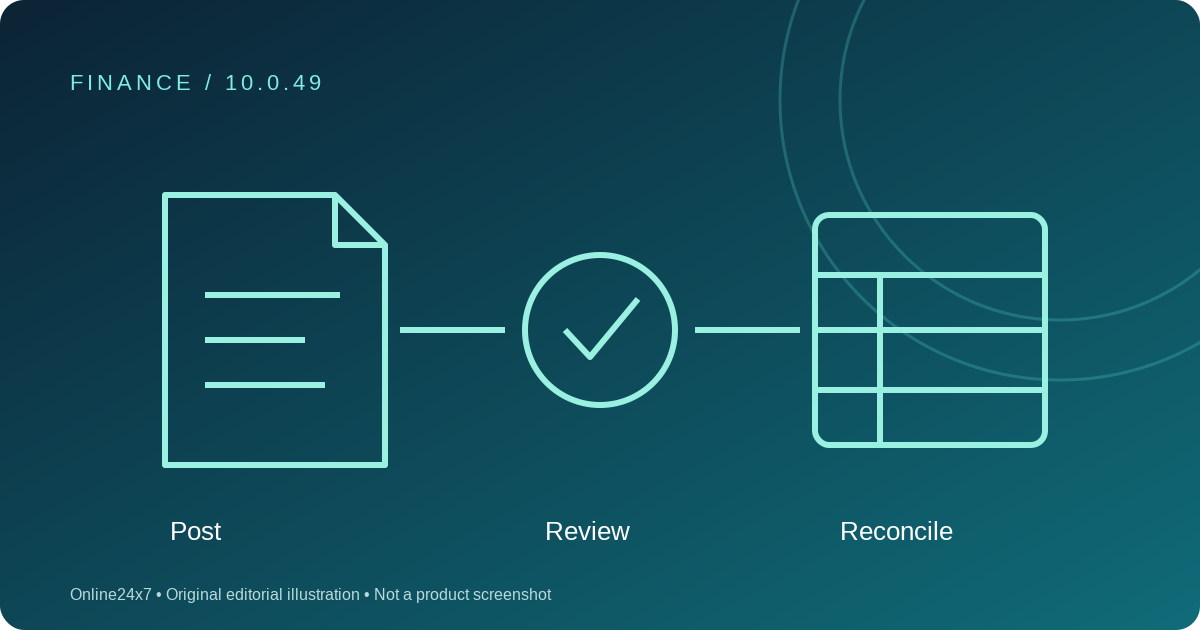
Finance updates change controls as well as screens. Version 10.0.49 deserves a process-led review because it touches payment posting, settlement, reconciliation and budget-controlled purchasing. The most useful question is not whether a feature appears in the release notes, but whether your team can explain its effect on an exception, an approval and the final accounting result.
Documented product facts are based on the Microsoft Learn sources below. Test scenarios and implementation advice are editorial recommendations, not Microsoft guarantees or client case studies.
Release facts and the boundaries of this guide
Microsoft identifies Finance 10.0.49 as build 10.0.2790. Its release-specific schedule lists preview in July 2026, general availability for self-update in September, and auto-update availability in October. As verified on November 23, 2026, this is the current generally available release covered here. The newer 10.0.50 documentation describes a December self-update release and January 2027 auto-update, not a release already generally available in November.
Application availability is not the same as universal feature readiness. The Finance article warns that some functionality is preview, and its feature tables distinguish parameters, administrator enablement, Feature management, defaults and mandatory changes. Treat the following implementation recommendations as Online24x7 editorial guidance. Confirm applicability, country coverage, enabled states and supported configuration in your own environment before changing production.
Separate payment posting from settlement deliberately
The release introduces delayed settlement: customer and vendor payment journals can post even when the associated settlement cannot complete. Settlement is queued separately and can be processed in the background or from a dedicated page. That distinction matters operationally. A posted payment is no longer sufficient evidence that the expected invoice has been settled when this capability is used.
Consider an illustrative distributor paying a vendor with disputed invoices. In a sandbox, create a valid payment and a settlement exception, then inspect the posted voucher, the open vendor transactions and the settlement queue. Verify who owns the exception, who can retry it, and how a duplicate retry is avoided. Your close procedure should identify unresolved settlement separately from failed payment posting rather than combining both into a single generic payment error count.
Use reconciliation previews as an approval control
Microsoft lists the ability to preview automatic bank reconciliation matching results before transactions are posted and marked as matched. For a team with complex matching rules, this creates a useful review point. It does not mean that a matching rule is correct simply because it produced a candidate. Reference quality, amount tolerances, bank charges, dates and duplicate statements still require validation.
A practical acceptance scenario includes two similar receipts, one exact reference match and one ambiguous amount-only candidate. Ask a cash-management user to review the proposed matches and demonstrate what happens when a candidate is rejected. Compare the resulting bank statement state and ledger postings against a known baseline. Keep evidence of the selected rule and expected decision, not just a screenshot showing that the reconciliation page opened.
Review bridge clearing and high-volume selection
The Finance notes also describe bridge-transaction clearance through reconciliation and more selective retrieval of bridge transactions. The latter lets users narrow selection using criteria such as bank account, vendor or customer account, payment reference, check number and date range. This is especially relevant when an unfiltered transaction list is operationally expensive.
Use realistic data volumes when validating the selection experience. A test with three transactions cannot establish whether the process remains usable at your normal payment volume. Record the filters, expected candidate population and elapsed time under a comparable workload. Avoid promising a percentage improvement: Microsoft describes the intended efficiency gain, but your extensions, transaction history and concurrent batch work determine the result in your environment.
Budget-controlled workflows need period-boundary tests
One significant budgeting change advances accounting dates for supported workflow-enabled purchase requisitions and purchase orders when the original period becomes closed or on hold. The documented behavior moves the date to the next available open fiscal period within the same fiscal year and re-evaluates budget control. That same-year condition is important; do not assume an arbitrary year-end rollover.
For an illustrative public-sector purchasing flow, submit a requisition before month-end and hold approval until after the period closes. Confirm the new accounting date, the applicable budget check, the downstream purchase order and reservation reporting. Repeat with insufficient budget and with no suitable open period. Your expected outcome must reflect supported system behavior, not a requirement that the workflow always succeed.
Diagnose tracking problems before attempting repair
The release adds detection of corrupt source-document budget-control tracking patterns, including orphan tracking records and broken relieving relationships. Detection complements existing maintenance and reprocessing tools; it is not a reason to run broad repair operations without evidence. Assign ownership to a finance administrator and establish a supported investigation path.
Capture affected document identifiers, reservations, commitments and the expected general-ledger relationship before maintenance. Reproduce the issue in a suitable nonproduction environment where possible and reconcile the result afterward. In the same review, evaluate workflow posting of general budget reservations and preservation of budget-check indicators after partial consumption or finalization. Both can alter how users interpret completion and budget impact.
Make Electronic Reporting changes observable
Electronic Reporting additions include native GS1 barcode formats, integer division and remainder functions, Print management copy-count behavior, optional memory optimizations and enhanced configuration validation management. These are different changes with different acceptance criteria. A barcode must be readable by the receiving process; a report calculation must return the right value; a copy setting must produce the expected output.
For document testing, retain approved reference files and compare representative documents containing long descriptions, multiple tax lines and unusual quantities. Validate copies through the actual destination path rather than only a preview. If you enable memory-related improvements, compare large executions under comparable conditions. Configuration-validation history can support governance, but it should supplement review of generated business documents, not replace it.
Define a small but complete accounting evidence pack
Before testing, agree which balances and document states will prove that a change is acceptable. For a customer prepayment scenario, retain the order, invoice, prepayment calculation, voucher and remaining open balance. Include both a normal case and a partial or corrected transaction. Where line-level prepayments are relevant, compare the header-level and line-level configuration using an agreed example rather than assuming that the visual total alone proves correct allocation.
The reviewer should be able to follow the same business amount from source document to ledger without asking the tester to reconstruct the run. Record the legal entity, currency, dates and applicable parameters with the result. If an amount differs, classify it as an expected rule change, incorrect configuration, invalid test data or a suspected defect. This discipline prevents a technically successful posting from masking an accounting outcome the finance owner has not accepted.
Do not overlook fixed assets or feature-state transitions
For India fixed-asset income-tax depreciation, Microsoft describes reporting-currency population with prerequisites: existing transactions must contain valid reporting-currency amounts, and zero amounts in relevant posted transactions or unposted journals can prevent enablement. A related reporting-currency adjustment capability is explicitly preview. These are not interchangeable features, and neither should be enabled solely because an upgrade was installed.
Finally, inventory defaults and mandatory transitions. The release lists changes across payment processing, settlement, budgeting, bank operations and other areas that may already apply without a new user request. Build a before-and-after feature register and have process owners sign off on relevant differences. A staged adoption decision, supported by traceable accounting evidence, is safer than turning on every optional capability during the same maintenance window.
- 01
Post
Payment voucher exists and balances correctly.
- 02
Settle
Invoice relationship is complete or explicitly queued.
- 03
Reconcile
Bank match has been reviewed and posted appropriately.
- 04
Evidence
Exceptions have owners and close-ready documentation.
Before you proceed
Implementation checklist
- Record the exact build, feature states, legal entities and affected process owners.
- Demonstrate payment posting and failed settlement as separate outcomes.
- Review accepted and rejected bank-match candidates with realistic statements.
- Test budget-controlled approvals across open, on-hold and closed periods.
- Reconcile fixed-asset currencies and validate enablement prerequisites.
- Compare ER output, copy counts and barcode readability against approved examples.
- Approve exception ownership and support instructions before production adoption.
Frequently asked questions
Does 10.0.49 enable every feature automatically?
No. The release mixes parameters, administrator settings, Feature management switches, defaults, mandatory changes and previews. Review each applicable row.
Is a posted payment necessarily settled?
Not when delayed settlement is used. Posting and settlement can complete separately, so operational monitoring should distinguish them.
Sources and verification
Verified 2026-11-23. Microsoft can revise feature scope, prerequisites and dates. Recheck the official source for production decisions.